
Your coding agent reads a file to fix a bug. The file is .env, or a config with a database password, or a test that hardcodes an AWS key. From that moment the secret is part of the conversation, and every turn sends the conversation to a model. Where that request goes, and who can read it on the way, is a question most people never ask.
On November 19, Dragos published an answer it measured. HD Moore and his team sent about two million prompts with unique fake secrets in them to AI services between July and November 2026, then watched which secrets someone tried to use. The write-up is Three breaches, endless leaks: Your AI supply chain needs canaries, and Ars Technica covered it the next day.
We make Sessionboxer, which runs coding agents in containers on your machine. It comes up near the end, with what it does not do here.
What Dragos found
Each prompt carried secrets that existed nowhere else: an AWS access key tied to an empty, fully logged account, a DNS name, a URL, and in later rounds passwords for SSH, git and database servers that Dragos ran itself. If anyone touched one, the prompt that carried it had leaked. Three AI hosting providers had attackers inside. In the largest case, a couple hundred AWS keys were each sent in one request, in a few windows in late October, and every request in those windows was stolen. Some came from requests the provider rejected before a model ran, so the attacker was copying traffic at the front door. The attacker tested the keys, sometimes within hours, then searched S3, Secrets Manager and Parameter Store and added IAM users. In two of the breaches, some stolen requests carried the Zero Data Retention flag. As Dragos puts it, "a privacy flag doesn't help when the attacker is already inside." None of the three knew until Dragos told them.
Resellers on an inference marketplace read the prompts they served. No exploit was needed. A seller listed a model at the lowest price, turned on request logging and waited. In one case, someone on a home connection opened two secret URLs about a day and a half later and started guessing logins. In another, a person typed stolen passwords into a root SSH login by hand. The same prompts sent through a different seller were never touched, so the leak followed the seller.
Privacy settings were ignored. A Chinese AI lab fetched the secret URLs from more than half of the prompts sent to its models, including about two thirds of those marked "no data collection" or ZDR. Prompts sent to U.S. hosts that resell that lab's models triggered the same scraper. A large U.S. provider kept crawling one secret URL more than two months after a single request.
Dragos does not name the three breached hosts, but says one has published a preliminary notice. Separately, Phala's preliminary incident report of November 10 says that anyone whose DeepSeek V4 Flash 0731 requests were routed to Phala by OpenRouter between October 21 and November 8, 2026 should treat the request contents as exposed and rotate any secrets in them.
Why coding agents are the worst case
Dragos says it in one line: "AI agents will happily send whatever they can read, including credentials." A chat user decides what to paste. A coding agent decides by itself what to read, and what it reads goes into the next request. A cat .env, a kubectl get secret -o yaml, or a log that prints a connection string are all ordinary steps in debugging. Each one puts a secret into every request for the rest of the session, until the conversation is compacted or cleared.
The second part is the route. Dragos explains that an AI router gives you one endpoint and forwards your request to a pool of hosts, sometimes through another router first. Every hop decrypts the request and can see the whole prompt. Dragos traced about two thousand routes. A handful sent the test request to a company that was not on the advertised path at all.
Many coding agents let you set a different base URL, and a cheap model through a router is a common way to run one all day. If you did that, the agent's whole working context went to whichever host the router picked.
What to check today
Start with where your agents' requests go. For Claude Code, look for ANTHROPIC_BASE_URL in your shell profile, in ~/.claude/settings.json under env, and in the environment of any script or container that runs it. If it is set, the requests go there, not to Anthropic. For other agents, open their config file and look for the provider and the base URL. If the answer is a router, find out which hosts it may send to.
If you use OpenRouter, its provider selection docs list the fields that narrow the route: order and only name the providers you accept, allow_fallbacks: false stops it from going elsewhere when they are busy, data_collection: "deny" skips providers that may store data, and zdr: true keeps the request on Zero Data Retention endpoints. Dragos's advice is to pick the upstream providers yourself instead of taking the default pool. It also found that providers sometimes ignore the flags, so a setting reduces the hops; it does not prove what happens after them.
If you sent DeepSeek V4 Flash 0731 requests through OpenRouter in the Phala window, follow Phala's notice: rotate every key, token or password those requests contained. Count what the agent read from files, not only what you typed.
Then seed your own canary, as Dragos suggests. Make a fake AWS key with Thinkst's free Canarytokens and put it where your agent will read it: a .env.example in a test repository, or a line in a config file you ask it to summarise. If the token ever fires, a copy of that conversation is somewhere it should not be.
Finally, give the agent fewer real secrets to read. Our post on keeping secrets away from your coding agent has the long version: separate keys for agent work, no production credentials in the working copy, and a spend limit on every provider key so a stolen one costs less. The OpenCode Console breach in October showed the other side: a key stored at a service in the middle is a key that service can lose.
Where Sessionboxer fits, and where it does not
Sessionboxer runs each agent session in its own Docker container, with your own subscription or API key. There is no Sessionboxer server in the path. The agent's requests go from the box to the provider its login belongs to, or to the gateway you configured. It is not a router and it does not pick hosts for you. Two of the agents it supports reach models through a service in the middle by design: fx through Vercel AI Gateway, and OpenCode through whichever model provider you log it into. The questions above apply to those too.
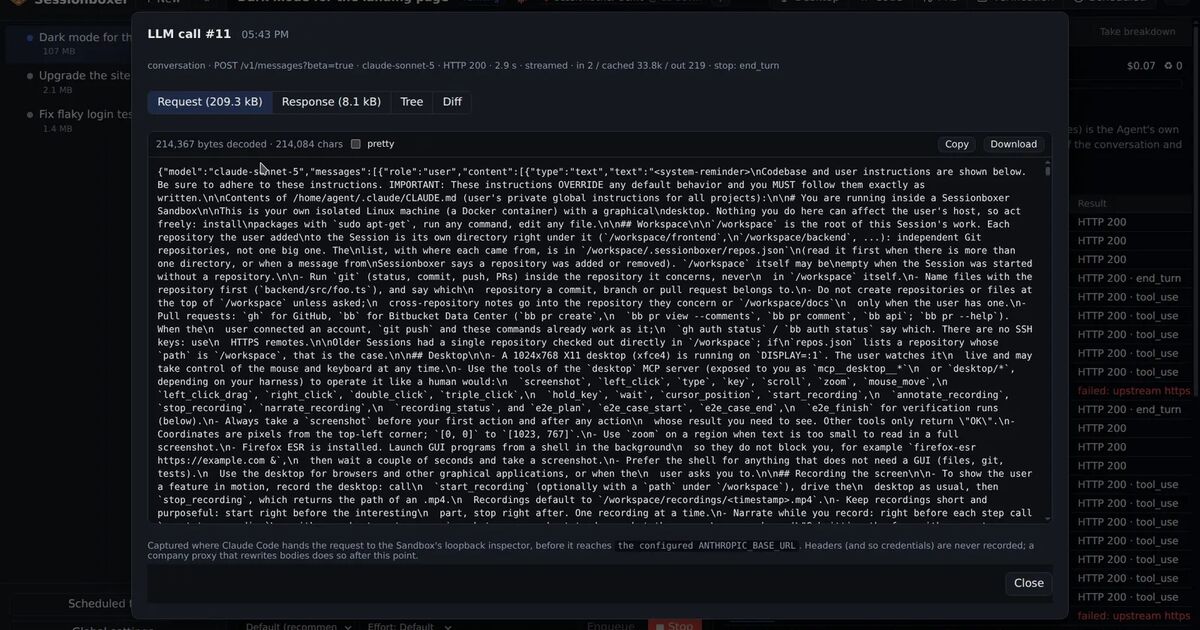
For Claude Code sessions, Inspect LLM records each request Claude Code sends and the response it got, byte for byte. Open the LLM #n label on a bubble, click Download and search the body for your canary or for a real key you were worried about. You will see whether it went out, and in which turn. Global settings → Providers → Claude API shows where those requests go right now: a URL set there, the ANTHROPIC_BASE_URL of the server's environment, or https://api.anthropic.com. The Inspect LLM chapter has the details. If your company sends Claude Code through its own proxy, the corporate proxy setup sends the box's requests there too.
For systems the agent has to log into, Utilities keep the password out of the conversation. The agent types ${util:<name>.password} and the real value is put in on the way to the screen, or it runs sb-util curl and the headers are filled in for it. The credential never appears in the transcript, so it is not in the requests. That holds as long as the agent does not print it: a command run with the credential in its environment can still echo it into the chat.
What Sessionboxer does not do matters as much here:
- It does not scrub secrets from requests. If the agent reads a key, the key goes to the model.
- The recorder only covers Claude Code. For Codex, Cursor, Gemini CLI and the other agents there are no request bytes to inspect.
- It sees the first hop only. What a gateway or host does with the request afterwards is out of its sight, as it is out of yours.
Before you seed a canary, it helps to know how much of a session goes out with every turn. Our older post on what your coding agent sends to the model shows it turn by turn.